Awaab's Law Phase 1 — live since Oct 2025Phase 2 — from 30 November 2026
From a complaint to clear evidence.
Two ways to run it. Open a case when a complaint arrives and issue a timestamped, sourced report inside the statutory 10 working days — or keep sensors in the property year round and see the conditions before anyone complains. Either way, every action is timestamped against the deadline it belongs to.
Moisture analysis follows the Building Moisture Index method published by the Property Care Association and UCL (Building Simulation, 2020).
Reports are built against the Housing Ombudsman's Spotlight recommendations 5, 11, 12 and 21 — a data-driven risk approach, diagnosis without blame, robust record keeping, and findings shared with the resident.
Timelines mapped to the Hazards in Social Housing (Prescribed Requirements) (England) Regulations 2025 and MHCLG guidance updated 31 July 2026, covering Phase 1 now and Phase 2 from 30 November 2026.
One case record from awareness through to written summary
Example view
RecordTriageInspectConclude
14-day monitoringEnvironmental evidence
Case-linked
Illustrative series — not case data
StartDay 4Day 8Day 12End
Relative humidityLogged continuouslyNot a spot reading
Surface temperatureCompared to dew pointShows condensation risk
External conditionsRecorded alongsideProvides a baseline
Next milestoneNext required action
The workspace shows the next outstanding duty and the event it is measured from. A due date appears only when the case pathway provides one.
Open case record→
Case recordEvidence, readings and decisions
Deadline-awareDates are measured from events
MAPLECase workspace•••
ILLUSTRATIVE WORKSPACE · NO RESIDENT DATA
Damp and mould investigation
One case record from awareness through to written summary
Example view
RecordTriageInspectConclude
14-day monitoringEnvironmental evidence
Case-linked
Illustrative series — not case data
StartDay 4Day 8Day 12End
Relative humidityLogged continuouslyNot a spot reading
Surface temperatureCompared to dew pointShows condensation risk
External conditionsRecorded alongsideProvides a baseline
Next milestoneNext required action
The workspace shows the next outstanding duty and the event it is measured from. A due date appears only when the case pathway provides one.
Open case record→
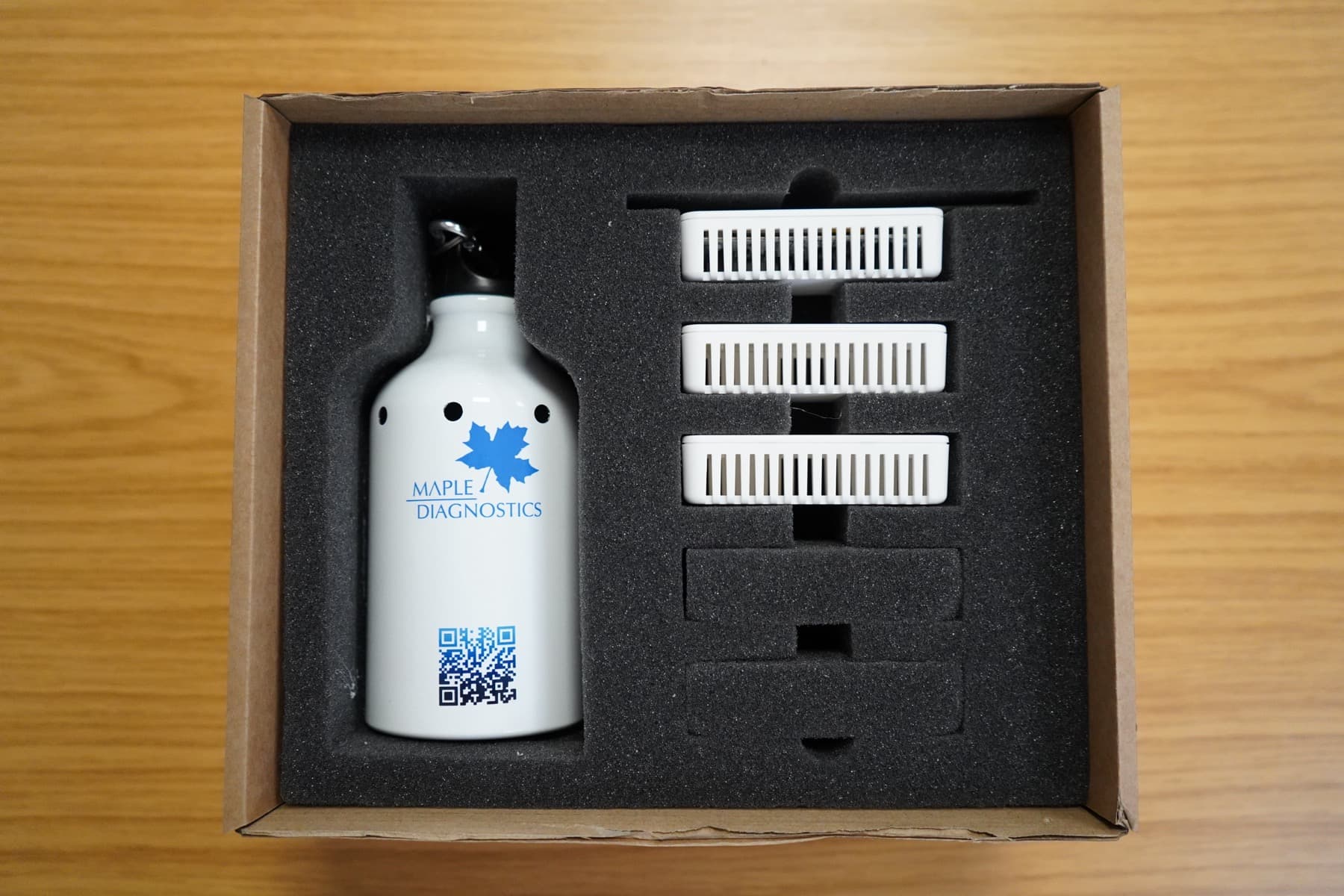
Three sensors and a logger, out for a 14-day investigation.
Built for the people responsible for resolving damp and mould
For social landlords: structure each case around risk, evidence, resident communication and the deadlines that govern the response.
Why Maple
Evidence backed up by data, not just photographs.
3 sensors
Measure what separates condensation from penetrating damp.
Surface temperature is read against the dew point of the air touching it, with an outdoor sensor as the control. A photograph can show mould. It can’t show why it’s there. Backed up by 2,000+ measurements per room, behind every finding.
Chained record
Change one entry, and the record shows it.
Every action is linked to the one before it, so an edit, deletion or insertion anywhere is detectable, and anyone can check.
Fingerprinted photos
A 15-shot photo survey, each one provable.
A guided survey covers every likely cause of the damp. Each photo gets a digital fingerprint the moment it arrives and keeps the camera’s own timestamp, so the image and the date can’t quietly drift apart.
Full readings data
Every reading, not a snapshot.
Surface temperature, air temperature and humidity every 30 minutes for 14 days: over 2,000 measurements per room, all charted in the report.
Research-based analysis
Methods from published, peer-reviewed papers.
Moisture is scored with the Building Moisture Index developed by UCL and the Property Care Association, and mould risk with published mould-growth models, each cited in the report so the method can be checked.
Excess cold and heat
Hours below 18 °C and above 26 °C, room by room.
The same readings show how long each room spent below 18, 16 and 12 °C, and above 26 and 28 °C, as Awaab’s Law extends to excess cold and heat from 30 November. Each band states a temperature, not a verdict, with its source printed in the report.
What we offer · Evidence for Awaab's Law
React to a complaint, or get ahead of one.
The same sensors, the same case record and the same evidence trail, run either way round. Start with a case, then keep the properties that concern you on monitoring. See what is in the kit →
Per case
Case investigation
A complaint arrives and the statutory clock starts. Sensors go into the property for 14 days, each action is recorded against the deadline it belongs to, and the report builder produces the findings and the written summary to the resident inside the window.
For a live complaint, a disrepair claim, an Ombudsman case.
Sensors stay in the property between complaints. Humidity, temperature and surface temperature are recorded continuously across the properties you choose, so the history exists before anyone complains.
And when a complaint does arrive, the history is already there.
For properties with a history, checks after remedial work, and stock-condition evidence.
One record carries the property, the household, the complaint, the measurements and the response. Nothing has to be assembled from email threads after the fact.
01
Set up the workspace
Register, name the organisation that owns the cases, and the workspace exists. Everything after this belongs to it: the properties, the cases, the evidence and the team who can see them.
02
Add the property
The building and the unit, recorded against their UPRN. That number is the join key the whole record hangs off — property, tenancy, hazard, investigation and report — and it is the same number your housing management system uses, so records can be matched.
03
Record the tenancy
Who lives there, the occupancy, and any reported health factors. That last part is special-category data under UK GDPR: it is held because it changes how a hazard is assessed, and it is restricted to the people who need it.
04
Open the case
Record the complaint and the date you became aware of it. That date is what every statutory deadline is measured from, so the clock starts on the record rather than in someone's inbox.
05
Investigate
Sensors log humidity, temperature and surface temperature every 30 minutes for 14 days, alongside the inspection and its photographs. The readings are scored by the Building Moisture Index; the hazard category is confirmed by the assessor, and the record keeps both.
06
Issue findings, then act
The report builder walks through cause, evidence, actions and the written summary to the resident. Make-safe work and repairs are recorded against the same case, so the response and the deadline it belongs to stay together.
Damp and mould disputes turn on what can be shown. These are the things a case record needs to carry for its conclusion to hold up later.
Continuous measurement
Humidity, temperature and surface temperature at interval, over a period long enough to show a pattern rather than a moment.
Evidence tied to readings
Photographs and inspection notes attach to the room and the time they describe, so an image and a measurement can be read together.
A record that shows any change
Every action is timestamped as it happens and chained to the one before it: awareness, triage, inspection, findings, work. Nothing is reconstructed afterwards, and nothing is edited quietly.
Findings about the building, not the household
Reports describe moisture loads and building faults, never resident “lifestyle”, in line with the Housing Ombudsman’s finding that blaming occupants is a systemic failure.
14 daysof continuous monitoring per case investigation
30 minbetween readings from each sensor, day and night
2,000+measurements per room, behind every finding
Awaab's Law
Deadlines the system counts for you.
In force since 27 October 2025 for social landlords in England. Working days, not calendar days, with bank holidays counted nation by nation. One deadline runs from awareness and the rest from the day the investigation concludes — concurrently, not in sequence. Which event each one is counted from is exactly where compliance is usually lost.
24hours
Emergency hazards
Where the hazard poses an imminent and significant risk of harm, it must be investigated and the safety work completed within twenty-four hours. Clock hours, not working days.
from awareness or the investigation
10working days
Investigate the hazard
A significant damp or mould hazard must be investigated and the investigation concluded within ten working days.
from awareness
3working days
Issue the written summary
The resident receives a written summary of the findings: the hazard identified, the action proposed, and the timeframe for it. It is not required where every necessary work — making the home safe and preventing recurrence — is finished inside the same three days.
from the investigation concluding
5working days
Complete the safety work
Where the investigation finds a significant hazard, the work to make the property safe must be completed — not merely started — within five working days. This window runs alongside the three-day summary, not after it.
from the investigation concluding
12weeks
Supplementary preventative works
Work to stop the hazard recurring must also be begun within those five working days. Where it cannot be, it must start as soon as possible and be physically started within twelve weeks — counted from the same event, not from the five-day mark.
from the investigation concluding
Closing a case doesn't clear its deadlines. No button makes a breach disappear.
Day zero is the day the landlord becomes aware; day one is the next working day. Read the full guide →
Start with a case, or start before one.
Open an investigation when a complaint arrives, or put a property on continuous monitoring and hold the history before you need it.